
tax blogs and articles

Reverse Mortgage
Home Equity Conversion
12.10.25
 
Mortgage (HECM)
Recently, I attended a Continuing Education session on Home Equity Conversion Mortgages (HECMs)—more commonly known as reverse mortgages.
 
While this is not an area I specialize in, the information was eye-opening. In my opinion, a HECM can be the right tool in the right situation, particularly for homeowners entering retirement or individuals planning ahead.  One of the more interesting options within the HECM program is the Line of Credit (LOC) Adjustable-Rate Mortgage (ARM). Like any financial tool, it comes with both benefits and potential drawbacks. 

Important Considerations


Even though a homeowner with a HECM is not required to make a traditional monthly mortgage payment, they must still pay Property taxes, Homeowner’s insurance, HOA dues (if applicable) and general maintenance.  There can also be Medicare/Medicaid implications, depending on the borrower’s circumstances, including where they live.

A Practical Example
Instead of diving into every technical detail of how a HECM works, I think an example is more helpful.

I’ll use myself.

In just over a decade, I will reach the minimum age of 62, which is when a homeowner becomes eligible for a HECM. Let’s say I decide to purchase either:

A 4-plex in the Kansas City area or a beach house in Florida to use as an Airbnb.  In either case, I could purchase the property now, operate it as a rental for the next decade or so, and then move into the property at age 62 or later, making it my primary residence.

Once it is my primary residence, I could potentially obtain a HECM Reverse Mortgage and eliminate the need for a regular “house payment” for the rest of my life—as long as I continue to live in the home, maintain it, and pay taxes and insurance.

The homeowner should research Medicare/Medicaid consequences, the Home Mortgage Interest Deduction, the lifetime exclusion amount and etc., but I believe it is worth spending 30-60 minutes researching the HECM, especially if you have a parent who is around 62 years of age.


SALT CAP DEDUCTION Loophole/Workaround
11/20/2025
 
The OBBBA increased the SALT Deduction CAM from $10K to $40K. However, there is a reduction of the CAP for high income taxpayers.
 
The phase-down of the OBBBA increased cap begins at $500K (less for married filing separately) of household income and completely phases back down to $10K for those making more than $600K (less for married filing separately).
The SALT cap loophole/workaround, for high income earners, potentially works in most states. In 2020 there was a notice issued by the IRS which ALLOWS the SALT cap loophole/workaround for high income earners.
 
If you are a high income earner, who is an owner of a pass-through entity (PTE); for example, some types of LLCs, partnerships, S Corporations you may be able to deduct your SALT above the SALT CAP.
 
Talk to your CPA because rules vary by state.
 
This strategy needs to be implemented BEFORE DECEMBER 31, 2025.
 
Tax Tips of the Day
Business Purchases

I’ve had a couple of conversations with people about buying an established business so I just thought I’d share a few opinions I have on the subject.
 
1. I would never just buy a business. There are about a million reasons for this but the main one is liability. For example, you buy a construction company that has a bunch of outstanding warranties, or back taxes or lawsuits or a hundred other things.
The former customers who own those warranties could come knocking at any time and then I, as the new owner of the business, could possibly be liable.
And you bet your bottom dollar the government and/or legal system will get their pound of flesh from me.
 
2. If I wanted to buy a business, I wouldn’t just buy the business. Instead I would buy everything that comes with the business (just not the name). I’d purchase the assets, agree to pay off any liabilities, buy the customer lists, various associated contracts and ect.
 
3. If I was wanting to buy ABC Widgets, I’d form a new company called AB&C Widgets and buy all the associated assets I thought necessary.
 
4. In the contract I’d have the current owner of ABC Widgets close down his company (IRS, associated Secretary of State and ect.). Going forward, ABC Widgets would no longer exist anywhere.
 
5. I’d have the current owner sign a non-compete. Non-competes have been notoriously bad at being upheld so I’d definitely consult a good attorney and have them write the non-compete up.
 
6. I’d have the current owner sign an employment contract for three years, where he works for the company and his compensation is on a sliding scale. His compensation would be dependent on how well the company does.
This way the current owner cannot just mail it in. It’s always a better idea to make it in his best interest to help you succeed the over the next few years.
 
7. I’d establish a board of advisors (can definitely be non-compensated). Ask a few professionals, experts in the field, and etc. to serve on your board. Treat them to a steak dinner every year or quarter and pick their brain about your current business strategy. You’d be amazed at the questions they could answer for you.
 
8. Last but not least. I’d always, always, always consult an attorney on any matters that remotely fall into the legal category. Everything from leases, to contracts, to employment law, entity creation to you name it.
 
9. And lastly, as self serving as it might be, consult with a CPA (like myself). It’s always better to measure twice and cut once when you are setting up your bookkeeping system. It can save you a lot of time in the the end.
There are probably about a 100 other things I could mention but these are the 9 things that immediately came to mind.
Tax Tips of the Day
Trump Accounts
 
I copied this from Whitehouse.gov. This is solely my opinion, but I believe this is possibly the first shot across the bow of the next generation’s Social Security.
 
• An American child born after December 31, 2024 and before January 1, 2029 for whom a Trump Account is established will receive an initial $1,000 deposit from the government, with the potential for parents to contribute up to an additional $5,000 per year1 initially.
o Employers may make an annual contribution of up to $2,500 to a Trump Account and that contribution will not impact the employee’s taxable income.
• CEA estimates that, under a scenario of average returns on the U.S. stock market, Trump Account balance for a baby born in 2026 will be:
o $303,800 by age 18 and $1,091,900 by age 28 if maximum contributions are made.
o $5,800 by age 18 and $18,100 by age 28 if no contributions are made.
Tax Tip of the Day
Tax Deduction for car loan interest.
10/21/2025
 
For the years 2025 through 2028 the OBBB has provided for a tax deduction for interest paid on a loan used to purchase a qualified vehicle.
 
The vehicle has to be for personal use and meet other eligibility criteria. If it meets those requirements then the taxpayer may be eligible for a maximum annual deduction of $10K and begins to phase out for taxpayers with Modified AGI over $100K (Single) and $200K (Married Filing Jointly)
 
Qualified Interest:
– Originated after 12/31/24
– Used to purchase a vehicle (used vehicles do not qualify)
– For Personal Use
– Secured by a lien on the vehicle

Tax Tip of the Day
Upstream Gifting

10/14/2025

To understand the benefits of this tax strategy, you’d first have to understand Stepped-Up Basis. Stepped-Up Basis is a valuable tax strategies many use to pass their assets down to their heirs.

For example
Person A has an apartment building they have had for 30 years. The property has appreciated over the years and depreciation has taken the property’s basis down to $0. If Person A sells the property he/she will have a pretty large tax bill.

However, if Person A passes away and leaves the property to Child B, then Child B will get the Stepped-Up Basis (the FMV of the property upon Person A’s death) of the inherited asset. This could potentially greatly reduce the tax bill of a future sale of the property by Child B.

Upstream Gifting takes the Stepped-Up Basis tax strategy and adds a wrinkle. Person C bought Nvidia stock when it was a dollar. It has appreciated over the years and Person C knows if they sell the stock it could result in a hefty tax bill.

Instead, Person C places/gifts the Nvidia stock to an Irrevocable trust and Person C grants Parent D the testamentary general power of appointment over the asset.

When Parent D passes, Person C’s heirs may be able to receive the assets at the Stepped-Up Basis. Because Person C is expected to live longer the Parent D, Person C’s heirs will be able to potentially receive the property, at FMV, much sooner.

Like any tax strategy, there are lots of things to consider such as gifting limits, organization structures and etc. But overall, this could be an effective way to transfer appreciated assets, such as real estate, to their heirs at FMV at an accelerated rate.


This Weeks Tax Tip:
Legal Marijuana Is there anything more interesting than the tax treatment of a controlled substance such as marijuana? What makes the tax treatment of marijuana so interesting is that while some states have legalized it, the federal government has not. MJ is on Schedule One of the Controlled Substance List. So what does any of this have to do with taxes?
Well drug dealers (whether illegal or not) and legal marijuana facilities/sellers are required to file tax returns. Because MJ is considered illegal on the federal level, they are only allowed to deduct their Cost of Goods Sold (COGS) on their tax return. Nothing else. Just the cost of their MJ inventory. This means that MJ facilities/sellers are only allowed to deduct the costs of the product they sell itself.
They are not allowed to deduct any other Overhead (OH) or general and administrative (G&A) costs. They CAN’T deduct other expenses such as salaries, rent, electricity, fringe benefits, mileage, cell phones, advertising, marketing, depreciation and etc. This results in potentially huge tax bills. Way bigger tax bills than what is usually representative of the revenue they receive. There is no other business that face theses restrictions.
What makes it more interesting is that in 2019 the Feds were taken to the US tax court by a taxpayer. The taxpayer stated that the fact that they are unable to deduct any OH and/or G&A costs is cruel and unusual punishment and excessive fines and/or penalties and that violates their 8th Amendment rights. The taxpayer also claimed that their 16th Amendment rights were also violated.
The 16th Amendment basically gives congress the right to tax income. The taxpayer claimed that by having to add back all of their non-COGS expenses, that they really weren’t getting their income taxed. It was much more. The US Tax Court shot down all of their arguments and sustained the Fed’s position. However, there was one dissenting opinion by Judge Gustafson.
He stated if you force a MJ facility/seller to add back in all of their expenses, other than COGS, is the IRS still taxing income? And if it’s not, is it not violating their 16th Amendment rights? He also stated that the IRS might also be violating their 8th amendment rights because if you make a MJ facilities/seller add back all of their expenses, other than COGS, is that not a penalty?
All that being said, it is my belief that one day a MJ facility/seller is going to win in tax court. And when that happens the values of these MJ companies are going to skyrocket because they will be paying WAY WAY less taxes.
 

Tax Tip

Safe Harbor for Small Taxpayers

10/10/25

Safe Harbor for Small Taxpayers
I had another potential client call yesterday afternoon where the taxpayer had around a dozen total doors, wife could probably qualify as a Real Estate Professional and they were looking into Cost Segregating their properties to harvest the tax losses in the year of the Cost Seg.
 
Between now and January, I’ll probably have a lot of these calls. Taxpayers will start looking for a new tax preparer and almost always the subject of Cost Segregation will come up.  Don’t get me wrong. I think Cost Segregations are a very powerful tool. But I feel as though it’s the automatic go to for every real estate investor who is looking for a tax deduction. During these calls I start asking questions about their situation and Real Estate goals. And for some, Cost Segs, are the answer. But for a majority, there is usually a different solution.
 
I ask them if their CPA has spoken to them about any of the Safe Harbors (Small Taxpayer, Routine Maintenance, and De Minimis). And the answer is always the same. The answer is always no. So I’m going to take a second and briefly describe one of the lesser known/used safe harbor, the Safe Harbor for Small Taxpayers. Without getting to much in the weeds, this Safe Harbor allows an annual expensing of up to $10K or 2% of the properties Unadjusted basis, whichever is less. It’s probably the most complicated of the three Safe Harbors.
 
Now there are some restrictions on the type of Real Estate, the value of the real estate, what types of expenses qualify, have to make a specific annual election and etc. that I’m not going to get into here, but overall, this Safe Harbor can be a very efficient way to reduce your tax bill.  And why this Safe Harbor can be more valuable than a depreciation strategy, such as a Cost Seg, is because almost always, expensing something is more tax efficient than depreciating it. Depreciation can lead to tax recapture, obliterated basis issues and etc., in the future.
 
Example:
A Qualifying Routine Maintenance cost: $8K
Unadjusted basis of the property: $600K
2% X 600K = 12K
Write off is the lesser of $10K or $12K
Can expense entire cost ($8K)


Tax Tip
Section 351 – ETF – Separately Managed Accounts (SMA)
10/7/25
 
Wealthy individuals with high unrealized gain positions can use this tax strategy to defer their tax gain on highly appreciated diversified Assets (this strategy won’t work if a considerable amount of the value is from a single stock like Nvidia).
 
For example, a taxpayer bought shares of various stocks ten years ago. Now these shares have appreciated and are worth a considerable amount more.
By moving these diversified assets from a SMA to an ETF the taxpayer is able to potentially defer the taxes on any capital gains. These ETFs may then be traded on an exchange.
 
This is a single use method that the taxpayer can use to move their appreciated stock shares to a potentially more tax-efficient vehicle. The gains remain unrealized and the newly formed ETF shares may then migrate back into the accounts of the contributing shareholders.


Conservation Easements
Sep 29, 2025

When I worked for the IRS we’d get these emails that summarized tax court rulings. A recurring subject would show up over and over again; Conservation Easements. The IRS would go after these deductions and would win Every. Single. Time. Over and Over the IRS would crush taxpayers who couldn’t support the dollar amount of the Conservation Easement deduction they took.

The lesson here is simple. If you are ever tempted to go to a seminar that discusses the tax benefits of a Conservation Easement. I’d probably do myself a favor and skip that one.
1099s for client “gifts”
Sep 19, 2025
 
I just reading a tax blog about how a tax preparer’s real estate agent client was getting hammered by the IRS for a $30K tax bill.  Usually you don’t have to issue 1099s for client gifts. However, there are a few nuances you have to be aware of.
 
– Referral gifts to clients are not really gifts. Those referral gifts are really a referral fee or advertising expense. If the annual amount paid is worth $600 or more then a 1099-NEC must be issued.
 
For example, a real estate agent gives a referral gift to any individual who refers to them a client. They will give them a $1K referral gift for any referred client who closes on a house. This would require that the real estate agent issue the individual receiving the referral gift a 1099-NEC.
 
– If you give away awards or promotional prizes in amounts greater than $600 you are required to issues the winner a 1099-MISC.
 
For example, you hold a drawing for a free trip and it’s Fair market value is worth more than $600 then you must issue the winner a 1099-MISC. Think Price is Right and Oprah.
 
– If you give an independent contractor cash or gift cards as a thank you for services then you must issue them a Form 1099-NEC (if the amount they received was $600 or more).
 
For example, you give your electrician a gift card to Lowe’s for $600 as a thank you for a job well done.


Legal Marijuana
Sep 19, 2025
 
Is there anything more interesting than the tax treatment of a controlled substance such as marijuana? What makes the tax treatment of marijuana so interesting is that while some states have legalized it, the federal government has not. MJ is on Schedule One of the Controlled Substance List.
 
So what does any of this have to do with taxes? Well drug dealers (whether illegal or not) and legal marijuana facilities/sellers are required to file tax returns.  Because MJ is considered illegal on the federal level, they are only allowed to deduct their Cost of Goods Sold (COGS) on their tax return. Nothing else. Just the cost of their MJ inventory.
 
This means that MJ facilities/sellers are only allowed to deduct the costs of the product they sell itself. They are not allowed to deduct any other Overhead (OH) or general and administrative (G&A) costs.  They CAN’T deduct other expenses such as salaries, rent, electricity, fringe benefits, mileage, cell phones, advertising, marketing, depreciation and etc. This results in potentially huge tax bills. Way bigger tax bills than what is usually representative of the revenue they receive. There is no other business that face theses restrictions.
 
What makes it more interesting is that in 2019 the Feds were taken to the US tax court by a taxpayer. The taxpayer stated that the fact that they are unable to deduct any OH and/or G&A costs is cruel and unusual punishment and excessive fines and/or penalties and that violates their 8th Amendment rights.
 
The taxpayer also claimed that their 16th Amendment rights were also violated. The 16th Amendment basically gives congress the right to tax income. The taxpayer claimed that by having to add back all of their non-COGS expenses, that they really weren’t getting their income taxed. It was much more.
 
The US Tax Court shot down all of their arguments and sustained the Fed’s position. However, there was one dissenting opinion by Judge Gustafson. He stated if you force a MJ facility/seller to add back in all of their expenses, other than COGS, is the IRS still taxing income? And if it’s not, is it not violating their 16th Amendment rights?
 
He also stated that the IRS might also be violating their 8th amendment rights because if you make a MJ facilities/seller add back all of their expenses, other than COGS, is that not a penalty?
 
All that being said, it is my belief that one day a MJ facility/seller is going to win in tax court. And when that happens the values of these MJ companies are going to skyrocket because they will be paying WAY WAY less taxes.


Low Income Housing Tax Credits
LIHTC
Aug 15, 2025
 
I think there a lot of Tax Strategies that get talked about over and over and basically get sliced up and repackaged over and over. By now almost every real estate investor has a basic understanding of Bonus Depreciation, 179 Depreciation, Depreciation recapture, Cost Segregation Studies, 1031 Transfers the STR Loophole, Real Estate Professional requirements and etc.
 
Less talked about are the Safe Harbors, Self Directed IRAs, and Opportunity Zones.
 
However, I’ve only run across a few who discuss 1202 stock, the tax strategy around using ETFs, SMAs and 351 together and, the subject of today’s post, Low Income Housing Tax Credits (LIHTC). It’s always been a little shocking that this tax strategy is not discussed more.
 
Maybe it’s because the “LIHTC pie” isn’t that big (even though it’s worth Billions) and the 9% (now 12%) piece has been pretty competitive? Maybe it’s the lower Corporate Income Tax Rate? I’m not sure.
 
But what I do know is that the OBBB increased the higher 9% credit to a permanent 12% and the lower 4% is also now easier due to the lowering of certain thresholds (5% & 25%) and is as close to a gimme as it’s ever been.
 
There are a lot of moving parts:
 
– The Company/Investor and Developer have to comply with the Requirements of IRS Section 42
 
– Usually, this only makes sense for Companies who have a lot of taxable income, therefore the need for Tax Credits
 
– The Company seeking the Tax Credits usually become the Investor
 
– The State Housing Agencies run the programs (The Tax Credits themselves are allocated from the Federal Government to the State Housing Agencies)
 
– Real Estate Partnerships are then usually formed to fund/develop these projects and then they apply for the LIHTC by submitting their applications to the State who then awards credits based on their Qualified Allocation Plan (QAP)
 
– Funds/Tax Credits can be awarded to these developments based upon a variety of factors contributing to the Qualifying Basis; such as percentage of low income housing, tax credit percentage, development costs and etc. (usually on an annual basis).
 
– The state can then approve the Developer’s Application and reserve the amount of credits requested.
 
– Once the Developers get their tax credits reserved then the Investors usually join as a Limited Partner and fund a part, if not all, of the project.
 
– Once everything is built, the city inspector should issue the certificate of occupancy, then the building is leased appropriately, and the Placed in Service package is submitted, examined, audited and approved,
 
– The State agency then should issue Form 8609 to the the partnership, then the developer sends the forms to the IRS. The Tax credits are then reported on the Partnership Tax Return and then flow to the individual partners tax return.
 
It is a very complicated process. But in my experience the greater the barrier of entry, the greater the reward.


Low Income Housing Rental Properties
Jul 16, 2025
 
With the passage of the OBBB there has been a lot of discussion about 100% bonus depreciation and Cost Segregation. But what I have not heard anyone talk about is how it can potentially really help those investors who deal with certain low income housing rental properties.
 
The depreciation recapture percentage, for certain low-income housing properties constructed, reconstructed or acquired after 12/31/74 or after, can phased out to $0.
 
This means these investors can potentially do an accelerated depreciation method on their low income housing properties and pay $0 in ordinary income of its disposition.
 
The investor may be able to decrease their depreciation recapture, from 100%, 1% each full month held in excess of 100 full months.
 
 
Example:
 
Investor of certain low income housing holds the property for 150 months and then sells. They used an accelerated depreciation method which would normally result in the gain potentially being taxed at ordinary income tax rates. However, he is able to keep 50% of the gain, resulting from the accelerated depreciation, from being taxed at ordinary tax rates (150-100 = 50).  
 
This is because the investor held the property for 50 months more than 100 months (total number of months held was 150 months).  The Investor was then able to reduce the gain by 50%.  1% for each month the property is held over 100 months.
 
The max the taxpayer potentially has to hold the property would be 16yrs and 8 months (200 – 100 = 100%). In this case, potential 0 depreciation recapture.
 
This is a complicated tax reg but can potentially bring enormous tax savings to those who invest in Low Income housing.


OBBB – Medicaid Funding
FMAP
Jul 8, 2025
 
The Federal government is reducing their FMAP (Federal Medical Assistance Percentage) for the Medicaid Expansion Program. The Feds are going to change their percentage from 90% matching to 80% matching.
 
Let’s say State A has Medicaid costs of $10Bil. Right now the Feds will pay $9Bil and the state pays $1Bil. With the reduction of the Federal Matching the Feds will only pay $8Bil and the state will have to pay $2Bil. This will be a huge change for states.
 
PROVIDER TAX RATE:
 
Right now the max tax for for expanded Medicare providers (nursing homes, hospitals, and etc.) is 6%. The state will tax the providers and the tax income will go into the State Medicaid budget. The Tax Rate will phase down from the current rate until it reaches 3.5%.
 
Less power to tax means the Federal government will have less dollars to match. This means there will be less money in the Medicaid budget. And less money that the Federal government will have to match.
 
FINANCIAL PENALITIES:
 
If states don’t follow the requirements set by the Feds (non-compliant states) by covering non-citizens, undocumented peoples and etc., then the Federal Government will give those states financial penalties.
 
Every quarter the Feds will give the states their quarterly matching amounts. If the states are found to be non-compliant then they potentially won’t get their Federal match.


ONE BIG BEAUTIFUL BILL
ADDITIONAL SENIOR TAX DEDUCTION
Jul 7, 2025
 
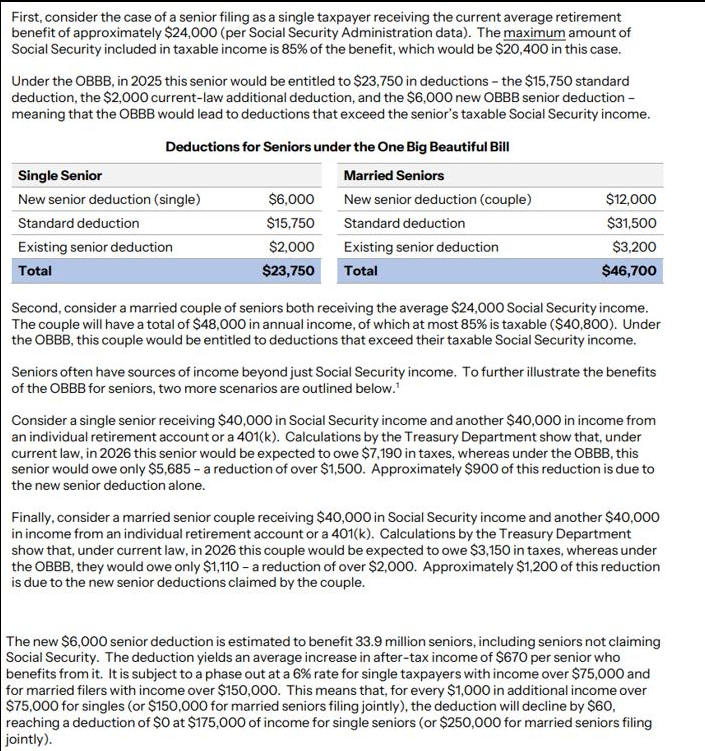
I snagged the following example from Whitehouse.gov. It illustrates how the New Senior Deduction can eliminate any and all Senior income. There are certain income phaseouts and limitations but here is the just of it.
 
Example 1
The 1st example illustrates how the average Single Senior Taxpayer’s retirement benefit (including Social Security) can be tax free.
The example states that the average retirement benefit is $24K (85% max taxable rate). This example show how the average retirement benefit of $24K would result in a taxable amount of $20.4K which is lower than $23.75K deduction, SO THE ENTIRE AMOUNT IS NOT TAXED
 
Example 2
The 2nd example illustrates how the average Married couple taxpayer’s retirement benefit (includes Social Security) can be tax free.
The example shows the average retirement benefit of a married couple is $48K (2 * $24K). That amount multiplied by the max taxable percentage of 85% is $40.8K. This number is less than the tax deduction for Married Seniors of $46.7K, SO THE ENITRE AMOUNT IS NOT TAXED
 
Example 3
The 3rd example shows what happens when you receive both Social Security income and other income such as IRA, 401K, tax free interest and etc.
The example shows how a Single Senior Taxpayer who receives $40K of SS Income and $40K from a 401K will pay a reduction of tax. There is a calculation you have to do using provisional rates to determine taxability, which I will show in another post, but the result is a tax bill of $5,685 which is a reduction of tax of over $1.5K for this Single Senior Taxpayer.
 
Example 4
The 4th example shows what happens when Married Senior Taxpayers receive $40K of SS Income and $40K from a 401K. Again there is a calculation you have to do using provisional rates to determine taxability, which will be shown in another post, and the result is a tax bill of $1,110, which is a reduction of over $2K.


Overtime
May 19, 2025
 
The Bill just passed the House with restrictions on owners of companies. So it won’t work for owners of companies as the bill stands, as passed by the House.
 
—–
 
Trump’s “One Big Beautiful Bill” – A Potential Game Changer for Small Business Owners
 
If passed, former President Trump’s proposed “One Big Beautiful Bill” could mark one of the most significant shifts we’ve seen for small business owners—possibly ever.
 
One provision in the bill stands out: no Federal Tax on overtime pay.
Let that sink in. If you’re a small business owner operating as an S-Corp and paying yourself a salary, this change could drastically reduce your Federal income tax burden.
 
For Example
Let’s say in 2024 you paid yourself a “reasonable salary” of $75,000 as an S-Corp owner. That full amount would typically be subject to Federal income tax.
 
Now, imagine using the Missouri minimum wage ($13.75/hour) as the baseline:
 
$13.75/hr × 40 hrs/week × 52 weeks = $28,600 base salary
 
That means any earnings above $28,600 could potentially be classified as overtime—and under this bill (as proposed), overtime income would be federally tax-free.
 
So you’d be shifting about $46,400 of your salary into a non-taxable category. Depending on your tax bracket, that could save you around $10,000 or more in Federal income taxes.
 
THIS IS JUST A BILL. IT HAS NOT PASSED. THERE IS THE POTENTIAL TO HAVE INCOME LIMITS AND A BUNCH OF OTHER LIMITATIONS PLACED ON IT, IF PASSED


Selling Stock at a loss to cover Investment Real Estate Gains
Unrecaptured and Recaptured Deprecation
Dec 22, 2024
 
I’ve had this question a few concerning this subject this year. Due to a bit of a perfect storm I’ve had a few clients that have had considerable gains in Real Estate and are sitting on stock losses.
 
DEFINITION:
 
LONG TERM CAPITAL GAINS:
– Difference between the sales price and purchase price
– Minimum Federal Taxable Rate of 20% + 3.8% (Obamacare)
 
UNRECAPTURED DEPRECIATION
– Straight Line Depreciation that was taken at the property (Usually taken at the taxpayer’s tax rate when taken)
– Taxed at Long Term Capital Gains of minimum of 25% + 3.8% (Obamacare)
 
RECAPTURED DEPRECIATION
– Depreciation that was taken at an accelerated rate.
– Taxed at Ordinary Income tax rates with a ceiling of 37% + 3.8% (Obamacare)
 
 
EXAMPLE:
 
– Selling Price – $250K
 
– Purchase Price – $150K
 
– Straight Line Depreciation – $20K
 
– Accelerated Depreciation – $30K
 
 
TAX (using given tax rates):
 
Long Term Capital Gain: $23.8K = ((250K-150K) X 23.8%)
 
Uncaptured Depreciation: $5.76K = (20K X (25% + 3.8%))
 
Accelerated Depreciation: $12.54 = (30K X (37% + 3.8%)
 
TTL TX = $42.1K
 
Therefore, if you have any stock losses that equal $42.1K then you can use them to offset the gains from the sale of this Investment Property
This example is not all inclusive. It does not account for unused passive gains, is not for primary homes, and etc.


Beneficial Ownership Information (BOI)
Dec 17, 2024
 
A Texas court struck down BOI reporting as unconstitutional. The US Government Entity is appealing (FINCEN).
Here is a good short informative link:
 
 
Here are the highlights:
 
– “New beneficial ownership information (BOI) reporting requirements that many small businesses were required to comply with by January 1, 2025, have been suspended nationwide under a new court ruling.
However, businesses can still voluntarily submit BOI reports, according to the U.S. Treasury Department’s Financial Crimes Enforcement Network (FinCEN).”
 
– “On December 3, 2024, the U.S. District Court for the Eastern District of Texas issued an order granting a nationwide preliminary injunction that:
Enjoins the CTA, including enforcement of the statute and regulations implementing its BOI reporting requirements, and,
Stays all deadlines to comply with the CTA’s reporting requirements.
 
The U.S. Department of Justice, on behalf of the Treasury Department, filed an appeal in the case on December 5, 2024.


Self Employed Health Insurance – Part II
Dec 2, 2024
 
S-Corporation – Single Owner:
 
For the S-Corp owner, First the S-Corp will pay for the Health Insurance Premiums. The S-Corp can pay the premiums using the business account resulting in a deduction on the S-Corp Business Tax Return.
 
Then gross up W-2 payroll. You do this by including it on the S-Corp’s owner’s W-2. Doing this will increase the S-Corp owner’s W-2 wage. The Health Insurance Premium costs are added to owner’s payroll that comprise the S Corp owners “reasonable salary”. This assists the S-Corp owner in avoiding paying payroll taxes on the Health Insurance Premium amounts. This can be a real tax saver.
 
Finally, the S-Corporation Owner will deduct the Health Insurance Premiums on on the S-Corp Owner’s Individual Tax Return via the Schedule 1 which flows to the S-Corp Owner’s 1040
.
Note 1: If either you or your spouse were eligible to participate in an Employer-Subsidized health plan, then for those months you are ineligible to take the Health Insurance Premium write-off.
 
Note 2: Health Insurance premiums paid by the company for their employees are deductible as Employee Benefit Program Expenses.
 
Note 3: The company has to have a positive Net Profit and/or Earned Income (not including Capital Gains)


Self Employed Health Insurance – Part I
Dec 1, 2024
 
Sole Proprietors & Single Member LLCs:
 
The Self-Employed can deduct their health insurance premiums (single or family). For those companies which are Sole Proprietors or Single Member LLCs the Sole Proprietor or Single Member owner of the LLC deducts the cost of the Self-Employed Health Insurance Premiums on their PERSONAL TAX RETURN.
 
This deduction is calculated on Form 7206, included on line 17 of SCHEDULE 1 which then goes to the taxpayer’s 1040, line 10. Do not take this deduction on the SCHEDULE C.
 
Note 1: If either you or your spouse were eligible to participate in an Employer-Subsidized health plan, then for those months you are ineligible to take the Health Insurance Premium write-off.
 
Note 2: Health Insurance premiums paid by the company for their employees are deductible as Employee Benefit Program Expenses.
 
Note 3: The company has to have a positive Net Profit and/or Earned Income (not including Capital Gains)


Injured Spouse
Nov 28, 2024
 
This IRS provision can be useful when your spouse understated taxes due on a Married Filing Jointly tax return and you didn’t know about the errors. Innocent Spouse Relief is only for taxes due on your spouse’s income from employment or self-employment.
 
The Injured Spouse may only request relief if a joint return was filed with your spouse, your taxes were understated due to errors on your return, the injured spouse did not know about the errors and you live in a community property state.
 
Injured Spouse Court Case:
In Freman vs IRS, 1/23/2023, Ms. Freman submitted a Form 8857 and the IRS issued a preliminary determination granting Ms. Freman full relief for the tax years at issue. However, the Appeals determined that Ms. Freman’s actual knowledge of the items of income made her ineligible for relief.
The Tax Court found that Ms. Freman is entitled to partial relief and found it inequitable for Ms. Freman to be held liable for all the tax debt.


American Opportunity Tax Credit (AOTC)
Nov 24, 2024
 
The AOTC is one of the ways the US Government encourages higher education. It is a tax credit for qualified education expenses, often times, paid for by an eligible student for the student’s first four years of higher education.
 
In most instances the student will receive a 1098-T from the educational institution they attended. This form will help the student calculate their Tax Credit.
 
The AOTC allows the student to potentially receive a maximum annual credit of $2,500 for the student’s first four years of higher education. There are eligibility requirements


Donor Advised Funds
Nov 22, 2024
 
A Donor Advised Funds is one of the more unique donation vehicles a taxpayer/donor can choose to donate to. It is a “separately identified fund or account that is maintained and operated by Section 501(c)(3) organization, which is called a sponsoring organization”.
 
One odd characteristics of a Donor Advised Fund is that a Donor may donate to the Fund and receive the tax benefit from it but the “donor, or donor’s representative, retains advisory privileges with respect to the distribution of funds and the investment of assets in the account”.
 
So basically a taxpayer can donate an asset (stock, cash, etc.) to a fund that is controlled by a Section 501(c)(3). The taxpayer/donor receives an immediate tax benefit and the Section 501(c)(3) has legal control over it but the taxpayer/donor retains advisory privileges


Back Door Roth
Nov 21, 2024
 
If you’d Google, “What is the most money I can make and still contribute to my Roth IRA?”, you’d probably find a table which gives out contribution limits for 2024. This table would that show you Modified Adjusted Gross Income (MAGI) limits for various filing statuses. And based on your income limits it would show you how much income you can make and still contribute to a Roth IRA. And if your MAGI exceed these limits then you wouldn’t be able to contribute to a Roth IRA.
 
While this information is accurate. It is incomplete. An individual Tax Payer can still make an unlimited amount of income and still be able to contribute to a Roth. In order to accomplish this, the individual taxpayer(s) need to make a non-deductible contribution and then convert it immediately to a Roth.
It’s called the Back Door Roth. And it allows anyone of any income level to contribute to a Roth IRA.


Estate Tax Exclusion
Nov 20, 2025
 
We’ve all heard stories of Taxpayers that have to sell off assets to pay the Estate Tax after their Billionaire parents die. Usually it’s after the owner of a professional sports team dies, leaving an Estate tax bill that can’t be paid by those inheriting the asset and they’re forced to sell off a portion of the team.
 
It doesn’t have to be a sports team. It can be a variety of assets including, cash and securities, real estate, insurance, trusts, annuities, business interests and other assets which are includable in the “gross estate of the decedent”.
 
For 2024 an Estate Tax Return (Form 706) has to usually be filed if the Decedent’s estate is over $13,610,000 (See the Basic Exclusion Amount (BEA) and Deceased Spousal Unused Exclusion (DSUE) amount) that we will subsequently discuss in a different Tax Tip of the Day).
 
This is the highest it’s been in a very long time and in 2026, the BEA is due to revert to its pre-2018 level of $5 million, as adjusted for inflation.
If you believe your gross estate will be between $5MIL and $15MIL on your death (depending on your age) then you should consider doing some tax planning; i.e., utilizing the annual gift tax exclusion, loaning money to relatives (comply with the Applicable Federal Rate) and etc.
 
There are certain anti-clawback provisions (BEA) but there have been many different administrations that publicly announced that it is their desire to greatly reduce the filing threshold for an Estate Tax Return. Some politicians have stated they would like it to be as low as $1MIL, which could really reach out and touch a lot of people.


Designated Beneficiaries
Nov 19, 2024
 
When the 20 year old’s marriage to the 90 year old failed, they had to come up with a different way to be a beneficiary to someone’s else’s retirement account. They hit up their 55yr old grandma and now the the 20 year old is a Designated Beneficiary to their grandma’s retirement account. While the tax deferment benefits are not as good as a Designated Beneficiary as compared to an Eligible Designated Beneficiary, there are still some tax advantages.
 
In most cases, the 20 year old granddaughter will have 10 years to distribute the funds from the decedent’s retirement account


Office in the Home
Nov 18, 2024
 
When applicable, every business owner should establish and document an Office in the Home. Even if you have another office somewhere else you can still have an administrative office in the home.  The greatest benefit of the Office in the Home deduction is not necessarily the actual deduction you receive from the office in the home (whether you use the standard or actual method). It’s usually the potential mileage deduction that can accompany it.
 
Once you establish your Office in the Home as your primary work location then every work related location that you travel to may qualify for the mileage deduction. And the mileage deduction of $.67 per mile can create a much bigger deduction the square footage.
If you own a S Corporation, there are a couple of additional hoops you have to jump through. But it is still possible


Board of Advisors
Nov 17, 2024
 
A mentor once told me that every business should have a Board of Advisors. They don’t necessarily have to have any responsibilities in the business but they are just there to advise the owners of the business.
 
The Board of Advisor meeting could be as simple as an annual dinner or it can be a bit more in depth, like a two or three day conference in a hotel.
Besides being a tax deduction, this meeting is a useful tool that can be used by the business owner to improve business performance and revenue.
Be sure to keep receipts, document the business purpose, have an agenda and etc.


Paying your Children – Payroll Tax
Nov 16, 2024
 
Is it possible to pay your minor child an infinite amount and not have to pay Payroll Tax (otherwise known as Social Security/Medicare and FICA)?
As long as your child earns it and you comply with IRS requirements (i.e., Accountable Plan, possible Family Management Company, etc.) then the answer is yes.
 
Example. You own a Real Estate Brokerage and you pay a 1% finders fee to anyone who brings you a deal. Your 16 year old child brings you a deal and the deal closes at $1MIL. Your minor child could possibly be paid a finder’s fee of $10K.
 
If your minor child does this 3 times in a year they could potentially earn $30K. This $30K is an expense to the parent, reducing the parent’s taxable income (including possibly reducing the parent’s Payroll Tax).
 
The minor child would not have to pay the $4,500 in Payroll Tax (not the same as Income Tax).
If you own a business have your minor child work in the business. They can shred papers, clean the office, computer work, take out the trash, and etc.
 
 
Head of Household
Nov 16, 2024
 
HOH is a filing status that can be very beneficial because it mainly allows for two significant tax benefits; a greater Standard Deduction and a more favorable tax rate (compared with Filing Single).
 
Per IRS Guidelines, “Generally, to qualify for head of household filing status, you must be able to claim a qualifying child or qualifying relative as a dependent. However, a custodial parent may be eligible to claim head of household filing status based on a child even if the custodial parent released a claim to exemption for the child.”
 
This is an area which can draw some attention from the IRS. Be careful to comply with the IRS guidelines (IRS Publication 501) when using the HOH filing status.  If audited it’s always a good idea to have supporting documentation to assist you in supporting your HOH filing status (i.e., rent receipts, grocery bills, lease agreements, utility costs, and etc.)
 
——–
 
Investopedia
 
In order to file as head of household, you must meet several requirements:
 
– Be unmarried
 
– Pay more than half of the costs of supporting your household
 
– Live with other qualifying family members for whom you provide support for more than half of the year. (Some examples of qualifying family members include a dependent child, grandchild, brother, sister, grandparent, or anyone else you can claim as an exemption.
 
Note: If the qualifying person is your dependent parent, they don’t have to live with you.
If you do not meet all of these requirements, you are not eligible to claim the head-of-household filing status


Eligible Designated Beneficiary (EDB)
Nov 14, 2024
 
So you are 20 and you marry a 90 year old. You might ask him/her to open a retirement account and make you the beneficiary.
Because you qualify as an EDB, you have the option of delaying the Required Minimum Distributions (RMDs) of the inherited Retirement Account. The IRS may allow you to withdrawal the funds over your lifetime and avoid the current associated tax consequences.
 
—————-
 
Courtesy of Investopedia
 
The five categories of EDBs include:
 
– A surviving spouse
– A minor child less than 21 years of age
– A disabled individual
– A chronically ill individual
– Any other individual who is not more than 10 years younger than the deceased account owner
 
An EDB can take a lump-sum distribution of the entire inherited account, withdraw the balance from the inherited IRA account over their life expectancy with required minimum distributions (RMDs) calculated annually by the plan, or follow the 10-year rule and empty the entire account by the end of the tenth year following the year of the account owner’s death.


Annual Gift Tax Limitations

Nov 13, 2024


– For 2024 the Annual Gift Tax Limitation is $18K
 

– For 2025 the Annual Gift Tax Limitation will be $19K

– School Tuition, Political Contributions, Charitable Donations, and Medical expenses could be excluded from the Annual Gift Tax Limitation

– A husband and wife may each give away up to $18K. This means a husband and wife couple may give up to $36K to a single grandchild, niece, nephew and etc., in 2024.
 
 
Qualified Longevity Annuity Contract (QLAC).
Nov 12, 2024
 
– Originated from the 2022 Secure Act 2.0
 
– Taxpayer can move up to $200K of funds from a Qualified Retirement Account (401K, IRA, or other Qualified Retirement Plan) into a QLAC
 
– It is a Deferred Income Annuity
 
– Allows you to possibly delay taking RMDs, and paying associated taxes, from age 73 to 85
 
– Guaranteed monthly income for as long as the taxpayer lives


Tax Deadline Tasks – File your Taxes
Jun 19, 2024
 
It’s roughly 2 months after the tax filing deadline. That leaves three categories of taxpayers; those that filed, those who filed extensions, and those who have done neither. To those of you who filed extensions, if you owe money to the IRS, the IRS will, in most circumstances, still charge you interest of 3% + the Fed STR and a Failure To Pay penalty of .5% per month, up to 25%
 
For those of you that have not filed an extension you are faced with everything above (Interest of 3% + the Fed STR and .5% per month) plus a Failure To File penalty of 4.5% per month.
 
Clearly the IRS wants you to file. Even if you don’t have the money to pay. For most American taxpayers, the IRS allows you to be put on a payment plan.
So, if you owe the Failure to File Penalty and Failure to Pay penalty then, in most circumstances, your total penalty is 47.5% (not including interest).
 
Example1:
You filed an extension but still owe the IRS $100. You pay the IRS when you file your taxes in October. To make the math easy let’s say the Interest rate is 6%. You’d owe the IRS $3 (6% divided by half a year = 3%) in Interest and $3 (.5% for 6 months) in Failure to Pay for a total of $6.
 
Example 2:
Same situation except an extension was not filed. The $6 above plus $22.50 for Failure to File
The point is clear. File your taxes. Even if you don’t have the money to pay.


End of the Year Tax Planning Strategies
Dec 23, 2023
 
As the year draws to a close make sure you have the following conversations with your tax preparer.
 
1. Ask them what mileage tracking documentation they need from you for 2023 to support your business mileage.
 
2. Do you have an Office in the home? If so, what kind of documentation do they need to substantiate this expense. Also, ask them to justify which method they plan on utilizing.
If you have a legit office in the home, most of the time you can expense it (yes, even if you have an S Corp).
 
3. Ask them the cost to prepare a Pro Forma Tax return for you. This could be valuable because you may want to discuss different tax saving strategies
For example, should you consider setting up a SEP or some other retirement account, should you buy a large purchase before the end of the year, and/or should you push off receiving a large payment into 2024 or pre-pay certain expenses.
 
4. Ask them to their opinion as to why you should NOT elect out of Bonus Depreciation for all Asset Classes for 2023. There may be reasons why you should or should not. But you need to have your tax preparer walk you through their reasoning for the why or why not.
 
5. There’s really not a good reason why you shouldn’t elect the De Minimis Safe Harbor every year. At least I haven’t heard of one.
 
6. Beneficial Ownership Information Reporting. This is BY FAR the most important bullet point. Talk to your CPA about BOI. This is a FINRA requirement and THEY ARE NOT MESSING AROUND. The penalties of non-compliance are severe. Make sure you understand when they are planning to complete your BOI and have them let you know once it is complete. I’m going to tell you right now. This one is going to be messy.
 
The above bullet points are not something that I pasted and copied form a website or blog article. Theses are all subjects I have experience with and deal with year over year.


IRS Form 8332
Release/Revocation of Release of Claim to Exemption for Child by Custodial Parent
Nov 1, 2023
 
This form is used by the Custodial Parent to allow the release and/or transfer of his/her claim to a dependent, for tax purposes. It gives the Non-Custodial Parent the right to claim the child as an exemption. It also releases any child tax credit benefit (such as Child Tax Credits, Earned Income Credit, and etc.) to the Non-Custodial Parent and it revokes any previous release of claim to exemption for the child.
 
This obviously has the potential to drastically reduce the tax owed by the Non-Custodial tax payer.


Child & Dependent Care Credit
Oct 16, 2023
 
If you work, or are looking for work, and you pay expenses for the the care of a Qualifying Individual then you may be able to claim the Child and Dependent Care Credit for those expenses. A taxpayer may be able to claim up to 20% to 35% of their total expenses for child care, up to a maximum of $3,000 (for one qualifying individual) or $6,000 (for two or more qualifying individuals).
 
Many taxpayers use this credit to offset some of the childcare expenses they pay daycares to take care of their children while at work. But this credit is not limited to daycare expenses. It might also be possible to use this credit to care for an individual who was physically or mentally incapable of self-care and lived with you for more than half of the year.
 
Why the Child and Dependent Care Credit is pretty awesome: A tax credit is a dollar for dollar reduction of taxes owed. While a tax deduction only reduces a taxpayer’s taxable income. A tax deduction only reduces the taxes owed by the taxpayer by pennies on the dollar.
 
——–
 
Topic No. 602, Child and Dependent Care Credit
 
 
Paying your Minor Child
Oct 14, 2023
 
How much money can your Minor Child make at their job or earn in dividends, interest and ect., in order to avoid filing a Federal Tax Return and/or avoid paying Federal Income Tax?
 
Your minor child has a job and your wondering if he/she is going to have to file a tax return for the money they earned from their W2 in 2023. Your minor child may not have to file if they earn less then $13,850 at their job.
 
Usually, if your minor child exceeds the threshold ($1,100, $2,300 or $12,750) of unearned income during the Year they might be required to file Form 8615 with their tax return. There are other requirements that are a part of Form 8615.
 
———
 
IRS Tax Form 8814, Parent’s Election to Report Child’s Interest and Dividends Form
IRS Tax Form 8615, Tax for Certain Children Who Have Unearned Income


“Qualifying Child” vs “Qualifying Relative”
Oct 12, 2023
 
It could be important to understand the difference between these two dependent classifications. A taxpayer could have a dependent who is one or the other. In most circumstances, it’s more advantageous for your dependent classified as a Qualifying Child.
 
A Qualifying Child has to meet all Five tests (Relationship, Age, Residency, Support and Joint Return).
 
A Qualifying Child may enable a taxpayer to claim several tax benefits, such as head of household filing status, the exemption for a dependent, the child tax credit, the child and dependent care credit and the earned income tax credit
 
A Qualifying Relative has to meet all Four Tests (Not a qualifying child test, Member of household or relationship test, Gross income test, and Support test.)
 
A Qualifying Child may enable a taxpayer to claim Head of Household, the Earned Income Credit, the Child Care Credit, and the Child Tax Credit.
 
““““““`
Publication 501
Dependents, Standard Deduction, and Filing Information


The Savers Credit
Oct 10, 2023
 
The Saver’s Credit or the Retirement Saving Contributions Credit, as it is otherwise called. This credit is pretty awesome because it reduces tax owed dollar for dollar; i.e., not taxable income, which is good, but just not as good as a reduction of actual tax owed.
 
The IRS states that this credit “helps offset part of the first $2K (married), $1K (Single) workers/taxpayers voluntarily contribute to IRAs, 401k plans and similar Workplace Retirement Programs”.
 
Workplace Retirement Plans include 401k, 403b, 457s, and TSP. A taxpayer whose AGI meets the below limitations could qualify.
– Married Filing Jointly – $73,000
– Head of Household – $54,750
– MFS & Single – $36,500
 
There are some other restrictions, but the bottom line is this; if you contribute to an IRA, 401K or Workplace Retirement Plan and your income falls under the above thresholds, you should make sure your tax preparer determines whether or not you qualify for the Saver’s Credit in filing 2023 taxes.
 
————
 
IRS form 8880
Credit for Qualified Retirement Savings Contributions


2023 Tax Tables
Oct 7, 2023
 
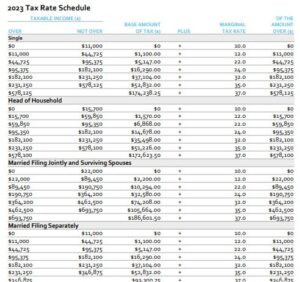
The IRS released the 2023 tax tables.
 
Remember the below amounts are for Taxable Income. That is the amount after all deductions have been excluded but before tax credits (which are way better because they are dollar for dollar).
 
So, if your Tax Status is Married Filing Jointly and together you had $100K in Taxable Income, then your 2023 Total Tax would be $12,615:
$12,615 = $10,294 + (($100,000-$89,450) * 22%


Buy Your Parents Home
June 10, 2022
 
The last Tax Tip topic concerned how if you don’t properly prepare for it, the costs of your golden years may not be so golden. As we grow older if we, as taxpayers, are caught unaware there are potential financial dangers lurking around every corner. I touched on this strategy in my previous post, but I wanted to spend some more time on it in order to give it it’s due.
 
So, what I’m going to share now is probably not going to be very popular. How do I know? Well, I broached this particular topic with my own family a few months ago and it wasn’t received with the pomp and circumstance that it adequately deserved. What am I talking about? I’m talking about buying your parent’s home….and then renting it back to them.
 
If you read any of my previous four posts, you know that the costs of an Institutionalized Spouse can literally eat away a lifetime of savings. And as you know, Medicaid can force the sale of the Institutionalized Spouse’s house and any other Exempt Assets after the couple has passed away. This leaves the heirs nothing. Everything has been gobbled up by the Medicaid machine.
 
I originally heard about this particular strategy from a lawyer/CPA I follow. What he stated was this, the adult children could buy their parent’s house and then the children rent it back to the parents.
 
Let me be clear. He wasn’t necessarily recommending this. But rather he was saying it could be a possible asset preservation strategy as well as a tax strategy. It takes the asset out of the parent’s names and gives their parents some extra walking around money. And even better, it also permits the children a tax deduction because now they own rental property and can possibly enjoy the almost limitless tax deductions that accompany real estate ownership.
 
Want a nice Christmas present? Visit your parents during the holidays and then write the whole thing off (limited to possible rental real estate income and other restrictions)!
 
Be sure to consult an attorney and your accountant concerning your specific situation.


Medicaid Nursing Home Income Rules (2021)
Part IV – Medicaid Summary and Discussion
June 5, 2022
 
So, we’ve gone over what happens in a Single Taxpayer Situation, a Married Couple situation where one spouse is Institutionalized, and finally what happens when both spouses are Institutionalized. The truth of the matter is that if a Taxpayer must be Institutionalized then none of the options are great. Things aren’t going to be great for the heirs or in certain circumstances the Community Spouse.
 
THIS IS IMPORTANT – If you are a Community Spouse and you took care of the house for most of your adult life and your Institutionalized spouse has earned and is receiving a great majority of the Married Couple’s retirement income, then you could be in for a very unfortunate lifestyle change. As the Community Spouse, not only are you going to have to sell off most of your assets, but you will also be living on around $3K per month. That could be an unexpected devastating change if you are used to living off $12K per month in Pensions and Social Security and thought you had $400K in savings to sustain the Community Spouse during your golden years
 
Previously we discussed Exempt Assets. A home is an example of an Exempt Asset. Based on the year and state of residence, you could possible be allowed to keep a home that has an equity up to $600K. But remember the house will be taken by Medicaid after the Taxpayer(s) death if Medicaid imposed their Estate Recovery Rights and forced the sale of all Exempt Assets. Also, consider if you are the Community Spouse mentioned above. In that case, it would be hard to keep a house that had $600K in equity, with only $3K per month. The Community Spouse would probably have to sell their house, even if it is an exempt asset.
 
Another element of the situation the Taxpayer(s) should consider is the Uncompensated Transfer Rule. On the Medicaid application, it asks if the applicant has transferred any assets out of their name for less than Fair Market Value (FMV) during the last 5 years. So, this is very interesting. I’m not a lawyer but I am an accountant and when I read the words FMV then that gets my mind going.
 
You may want to discuss with your accountant and attorney what happens if you sell your assets at FMV during the last 5 years. If so, do you have to put anything on the Medicaid Application concerning the Uncompensated Transfer Rule? My very very non-CPA advice, I mean I’m just thinking out loud here is….No. No, you wouldn’t have to. If you sold your house for FMV at 70 years of age and then took the cash and took that super cool trip to Europe…then you spend the money. You no longer have it. And…again, what I’m just thinking out loud here is, you wouldn’t have to put your house as an asset transferred out of your name for less than FMV during the last five years if you applied for Medicaid at 72 years of age.
 
Now I’m going to throw a monkey wrench in things here…if you sold your house and then gifted your kids $10K each you would then have to say “yes” on your Medicaid application. Because, if you gifted your kids $10K, then you transferred assets out of your name within the last 5 years. Don’t get Gift Tax limit of $16K per donor per recipient, confused with an Inheritance Tax (which is a state tax) with an Estate Tax (which is taken out of the estate upon death). What we are talking about is Medicaid and Medicaid eligibility only.
 
Talk to your Lawyer and Accountant about Family Trusts. It needs to be a customized and personalized trust that prohibits the remaining principal from putting it back in their name. The Revocable Living Trust (RLT) IS NOT a way around this. Many believe that the RLT’s main purpose is to avoid probate not as a work around to the Medicaid dilemma. Another thought is this. Transfer the assets out of your name and hope you make it past the five-year lookback before you need to be Institutionalized.
 
The point is this. DON’T BE CAUGHT UNAWARE. UNDERSTAND YOUR SITUATION.


Medicaid Nursing Home Income Rules (2021)
Part III – The Married Couple – Both Are In a Nursing Home.
June 4, 2022
 
First things first. I am not a Medicaid expert and the numbers I am going to present in this post are from 2021 and can vary from state to state, so please do your own research.  What happens if both sides of a Married Couple are in a nursing home? If both individuals are considered Institutionalized Spouses, then this is probably the worst-case scenario.
 
Like the examples before, my numbers are not going to be identical to your situation. So please don’t rely on my numbers and be sure you consult an attorney. A lot of the Medicaid rules are similar to the two previous posts, but some of the limits and rules are a bit different. Like always, I think these things are always best explained in an example.
 
In this situation, both spouses are Institutionalized. The Asset Limit is $3K (outside the Exempt Assets). An Institutionalized Married couple has $350K in Assets (outside of Exempt Assets). This means that they are going to have to spend down over $347K of their own Assets first before they meet the Medicaid Asset Test. That’s right. They scrimped and saved over $347K in Assets over the course of their life and in less than 2 ½ years it is completely gone. That’s honestly terrible.
 
And it gets better. Once the Institutionalized Spouse(s) have sold off their assets and qualify for the Medicaid Asset test then they both have to assign their income to the nursing home. That’s right. BOTH OF THEM have to assign all of their Pensions, Social Security, and etc., to the nursing home and then Medicaid will pick up the rest. The good news is, just like the Single Taxpayer, they each get to keep a $38 personal needs allowance.
And like the Single Taxpayer, when they pass away, Medicaid can force the sale of the Exempt Assets (House and Car) via Estate Recovery Rights. Then Medicaid will pick up the difference. So just like the other examples, nothing will be left.
 
In review, if the Married Couple Taxpayers are both Institutionalized and they had saved $350K in assets and they both end up in the nursing home (Institutionalized Spouse(s)), then they are required to spend down over $347K of their own assets first. Therefore, the Institutionalized Spouse(s) will wipe out the Married Couple’s Assets in less than 2 ½ years at $6K per month ($72K per year X 2 = $144K per year for both spouses).
 
 
Okay. Last post we discussed the Nursing Home strangulation of a Single Taxpayer. Like before, my numbers are not going to be identical to your situation. So please don’t rely on my numbers and be sure you consult an attorney.
We are now going to discuss the situation of a married couple where one is in a nursing home (Institutionalized Spouse) and the other spouse is either living at home, or in an assisted living facility or etc. (Community Spouse). A lot of the Medicaid rules are the same, but the limits are a bit different. Community Spouse Resource Allowance is $130K (Assets the Community Spouse is allowed to have). I think these things are always best explained in an example so keep on reading.
 
Let’s say a Married Couple has $300K in Assets (other than the previously discussed Exempt Assets). The Married Couple will have to spend down over $170K of their own assets for the Institutionalized Spouse first. This allows the Community Spouse $130K + $2K in Total Assets.
After the Married Couple spends down their Assets FIRST, and the Medicaid Asset Test met, then Medicaid will kick in. For income, let’s just say that the Community Spouse is allowed, via Medicaid rules, to keep $3K. However, if the Community Spouse’s income (Social Security, Pension, and etc.) is $10K then the Community Spouse would get to keep all of it. However, if the Community Spouse’s income (Social Security, Pension, and etc.) is only $1K then the Community Spouse would be able to take income from the Institutionalized Spouse until the Community Spouse received income of up to $3K.
I know that was a lot. The Bottom line is this. If the Community Spouse’s income is more than $3K then they get to keep all of it. However, if the Community Spouse’s income is less than $3K then they get to keep enough of the Institutionalized Spouse’s income to bring their income to $3K. The rest of the Institutionalized Spouses income is taken by the nursing home and the difference is covered by Medicaid.
 
Similar to the Single Taxpayer example, after the Married Couple passes away, Medicaid can force the sale of all Exempt Assets (house, car, etc.) of the Married Couple, via Estate Recovery Rights. So just like the Single Taxpayer, after that happens, Married Couple’s heirs will probably receive nothing.
In review, if the Married Couple Taxpayers saves $300K in assets and one of them ends up in the nursing home (Institutionalized Spouse), then they are required to spend down over $170K of their own assets first. Therefore, the Institutionalized Spouse will wipe out over half of the Married Couple’s Assets in less than 2 ½ years at $6K per month ($72K per year). However, if available, the Community Spouse will be able to keep up to $3K in income.
Next, I will go over Part III – The Married Couple – Both Are In a Nursing Home


Medicaid Nursing Home Income Rules (2021)
Part I – The Single Taxpayer
June 3, 2022
 
I was going to discuss something else today, but I decided to mix it up. I feel like this is a very important topic and has the potential to affect every one of us. I am not a Medicaid expert and the numbers I am going to give in this post are from 2021 and can vary from state to state, so please do your own research. Okay. Here we go.
 
A Single Taxpayer going into a nursing home is subject to an Asset Limit of only $2,000, other than exempt assets (such as your house, car, prepaid funeral expenses and etc.). This means if the Single Taxpayer has managed to save $100K over his/her lifetime he/she will have to spend down $98K of their own money, other assets, and resources FIRST and then they’d qualify for Medicaid. This is called the Medicaid Asset test. If the Single Taxpayer has saved over $250K over his/her lifetime he/she will have to spend over $248K of his/her out of their own pocket and then they’d pass the Medicaid Asset Test.
 
Basically, all the money the Single Taxpayer scrimped and saved over their lifetime does not mean a whole heck of a lot when you think about how much per month the nursing home costs. Let’s say that the nursing home costs $6K per month ($72K per year). If the Single Taxpayer saved $250K over the course of their life, then the cost of the nursing home would eat up your life savings in less than 3 and ½ years. Let that sink in. In less than 3 and ½ years the Single Taxpayer will have lost everything they saved their entire life for. Seems fair right?
 
Once the Single Taxpayer sells all their Assets and spends down their assets below $2K and passes the Medicaid Asset Test then the Single Taxpayer is required to assign their income to the Nursing Home. The terrific news is that the Single Taxpayer will get to keep $38 per month (Personal Needs Allowance). So basically, the Single Taxpayer is required to assign all their income to the Nursing Home, including Pension, Social Security, and etc.
 
All the Single Taxpayer’s income gets assigned to the nursing home. ALL OF IT (except $38). Then Medicaid will pick up the difference. Pretty good deal if you ask me.  And even better. After the Single Taxpayer dies, Medicaid will force the sale of all Exempt Assets (house, car, etc.) via Estate Recovery Rights. So, after that, there will be nothing left.
 
So, there you go, if the Single Taxpayer saves $250K in assets and end up in the nursing home for over 3 ½ years then they are completely wiped out. Zero dollars left. I guess a penny saved isn’t always a penny earned
 
Next, I will go over Part II – The Married Couple – Only One Person In a Nursing \\Home.


529 Accounts - Special Needs Trust (SNT)
May 28, 2022

Able Account and Special Needs Trust (SNT). The Able is one of the more useful 529 plan. If you have a special needs child or loved one then it doesn’t hurt to read everything you can about special needs strategies. Also, unlike an educational 529 plan, there aren’t quite as many options for special needs individuals.
Contributions to the Able are not tax deductible but distributions for qualified disability expenses are tax free. The Able account could possibly have a limited effect on the eligibility of SSI, Medicare, FASFA, HUD, and SNAP/food stamps.

Additionally, there are eligibility age and income requirements. The SNT is pretty complicated and has a lot of moving parts. One of the main purposes of the SNT is to take care of the special needs dependent after the dependents caretakers are no longer around and to preserve government benefits.
There are several types, variations, and features of a SNT. There are Third-Party Special Needs Trusts, otherwise known as Family Trusts, First-Party trusts, Pooled trusts, and etc.

There are also second-to-die whole life insurance policies and the 529 Able (which is referenced above). Be sure to consult an attorney and your accountant before trying to open up a SNT.


Coverdell 
May 26, 2022
 
Let’s talk about the Coverdell ESA (Educational Savings Account). If you are looking for a tax friendly vehicle to save for your child’s qualified education expenses look no further than the Coverdell.  You can use the Coverdell, in combination with your kid’s Roth IRA, and you’ll find that you will have a nice chunk of change squirreled away for your child’s education.
 
Yes, you can put almost 10X more per year into a 529 plan but you’d probably see the same results if you lit the money on fire and then put the fire out by peeing on it. The point is the results on a 529 plan are terrible. TERRIBLE. After you take into account the fees and other charges you have to pay, you’ll find your returns are not great (look at your statements and you’ll see I’m right). Even worse, once you put your money in a 529 plan the money is stuck there.
 
So do the right thing for your kids qualified education expenses. If your kid is under 18 and you want tax growth and withdrawal then consider a Self Direct your Coverdell (yes you can self direct your Coverdell) and kid’s Roth IRA. I’d think twice before contributing another dollar to 529 plan.
Yes, there are income limitations, but friends and relatives can contribute so you can gift money to them and have them contribute to your child’s Coverdell.
 
6/3 – Tax Tip #4 – Back Door Roth
6/10 – Tax Tip #5 – Office in the Home
6/17 – Tax Tip #6 – Revocable Living Trust


Capital Gains
May 2022
 
1) If you sold/are going to sell stock, a business, house, crypto, or anything else that will cause a capital gain for you in 2022, consider investing in an Economic Recovery Zone. Push off your tax bill till 12/31/26 and if you keep the investment for 10 years you won’t have to pay any capital gains on any appreciation. This is a fairly complicated piece tax legislation so IM me if you have any specific questions.
 
2) Self Direct your IRA or at least part of it. I don’t get a referral fee nor do I have any interest in any firm/company that sells Self Directed IRAs. I consider this a public service announcement.
Self Direct your retirement account or HSA. Use your retirement account or HSA to buy a house, land, part of neighbor’s business, flip a house, buy a cow (yes. You can buy cow with your retirement account); basically anything you can invest in, your retirement account can invest in as well (there are some prohibited persons and other exclusions).
 
Here’s an example, are you in your 40s and know where you want to retire? Buy the house with your Roth and move in when you retire and start taking distributions. All tax free. If you want to understand the power of a Self Directed IRA Google Peter Theil. $5 Billion in a Roth. Try doing that the regular retirement way. No one has ever come close since you can only contribute up to the max every year.